Ever felt confident about a trade only to see it go completely wrong?
It happens more often than you think. Many beginners enter the market with excitement, hoping to make quick profits. But after a few losses, reality hits hard. The problem isn’t always the strategy, it’s the lack of protection.
That’s where risk management in trading becomes your safety net.
Think about it. If you lose a big portion of your capital early, how will you continue trading? That’s why experienced traders don’t chase profits first, they protect what they already have.
If you’re learning from a Stock trading institute in Hisar, Haryana, you’ll notice this mindset is taught from day one. Because trading isn’t just about winning trades. It’s about staying in the game long enough to grow.
Let’s understand this in a simple, practical way without complicated jargon.
What is Risk Management in Trading?
Risk management in trading is the process of protecting your capital by controlling potential losses. It includes strategies like using stop loss India, maintaining a proper risk reward ratio India, and following strict trading discipline Hisar. The goal is not just to make profits, but to ensure long-term survival in the market.Risk management in trading simply means deciding how much you are willing to lose before entering a trade.
Sounds basic, right? But this one habit can change everything.
Instead of hoping the market goes your way, you prepare for the opposite. You accept that losses are part of trading and you control them.
Imagine riding a bike without brakes. Would you feel safe?
That’s exactly what trading without risk management feels like.
With proper planning, you limit your losses, protect your capital, and trade with clarity instead of fear.
It’s not about avoiding losses completely. It’s about keeping them small.
Why is Risk Management Important in Trading?
Let’s be honest, losses are unavoidable in trading.
But big losses are preventable.
Here’s why risk management matters so much:
- Protects your capital from sudden market moves
- Helps you recover from losing trades
- Reduces emotional stress and panic
- Builds strong trading discipline Hisar
- Keeps you consistent over time
If you lose 50 percent of your capital, you need 100 percent profit just to recover. That’s not easy.
This is why traders in a Stock trading institute in Hisar, Haryana are trained to think differently. They focus on survival first.
Big losses destroy accounts
Small controlled losses build long-term success
How Does Risk Management Work?
Let’s break it down into easy steps you can actually follow.
Step 1: Decide Your Risk Per Trade
Before entering a trade, ask yourself
How much am I okay losing here
- Risk only 1 to 2 percent of your capital
- Example: 1,00,000 capital means risk 1,000 to 2,000
This keeps your losses manageable.
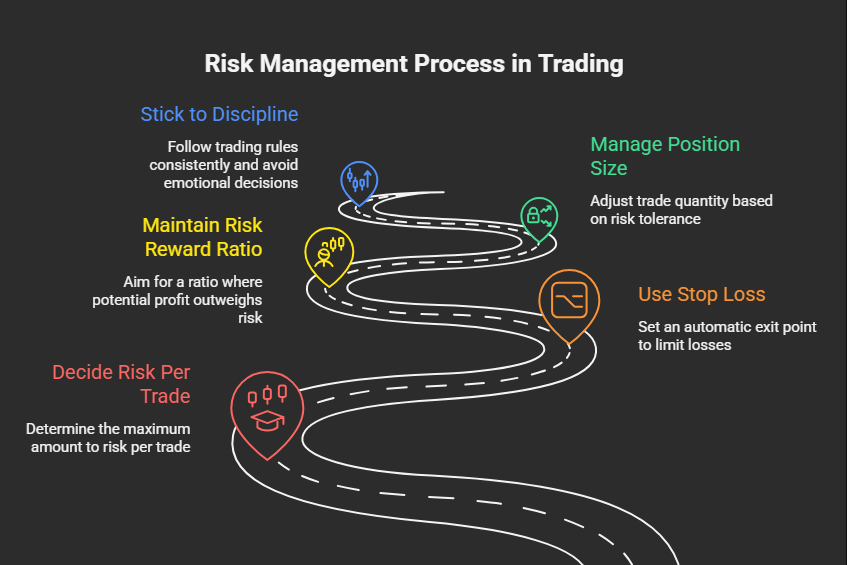
Step 2: Always Use Stop Loss
A stop loss India is your exit plan.
It automatically closes your trade if the price goes against you. No emotions. No second-guessing.
Skipping stop loss is like saying let’s see what happens. That rarely ends well.
Step 3: Maintain Risk Reward Ratio
This is where smart trading begins.
- Aim for at least 1:2 risk reward ratio India
- Risk 1 to earn 2
Even if you win fewer trades, you can still be profitable.
Step 4: Manage Position Size
Don’t go all in.
Adjust your quantity based on your risk. This is called position sizing, and it quietly protects your capital.
Step 5: Stick to Discipline
This is the hardest part.
You know the rules. But will you follow them?
- Avoid revenge trading
- Don’t increase risk after losses
- Stay patient
This is where real traders stand out.
Control risk, use stop loss, follow rules, stay consistent
Benefits of Risk Management in Trading
Once you start following risk management, you’ll notice a shift, not just in results, but in mindset.
- You stop fearing losses
- You gain control over your trades
- You think long-term instead of reacting impulsively
- You improve trading safety India
- You protect your capital consistently
Real-life example
A beginner in Hisar started trading with 50,000. In the first month, he lost nearly half because there was no stop loss and no plan. After joining a Stock trading institute in Hisar, Haryana, he learned to risk only 2 percent per trade. Losses became smaller, confidence improved, and slowly, profits followed.
That’s the difference structure makes.
Trading Without Risk Management vs With Risk Management
| Factor | Without Risk Management | With Risk Management |
|---|---|---|
| Loss Control | No control | Limited losses |
| Emotional Stability | Stress and panic | Calm decisions |
| Consistency | Random results | Stable performance |
| Capital Protection | High risk | Strong protection |
| Growth | Short-term | Long-term |
Who Should Use Risk Management?
Honestly, anyone who wants to survive in trading.
But it’s especially important for:
- Beginners who are still learning
- Intraday traders dealing with volatility
- Swing traders holding positions overnight
- People with limited capital
- Anyone serious about capital protection trading
If you’re trading without it, you’re relying on luck. And luck doesn’t last long.
Pricing Factors
Here’s the interesting part. Risk management itself doesn’t cost anything.
But learning it the right way does matter.
You might invest in:
- Professional trading courses
- Mentorship programs
- Live market training
At a Stock trading institute in Hisar, Haryana, you don’t just learn theory. You see how risk management works in real-time markets.
One avoided big loss can recover your learning cost.
Industry Trends in 2026
Trading is changing, and risk management is becoming more advanced.
Here’s what’s happening:
- AI tools are helping manage risk automatically
- Smart platforms offer built-in stop loss systems
- Algorithmic trading uses strict risk rules
- More institutes focus on trading discipline Hisar
- Awareness about trading safety India is growing
Today’s traders are smarter.
They don’t just ask how much can I earn
They ask how much can I lose safely
Modern trading focuses on risk first and profit second
Why Choose Mr Trade and Stocks in Hisar, Haryana?
Learning trading alone can be confusing.
You try strategies, watch videos, follow tips, but something still feels missing. That missing piece is structured guidance.
At Mr Trade and Stocks, the focus is clear:
- Learn real risk management techniques
- Understand capital protection trading
- Practice with real market examples
- Build strong trading discipline Hisar
- Get step-by-step support as a beginner
Instead of trial and error, you follow a proven path.
And that makes all the difference.
FAQs
- What is the 1 percent rule in trading
It means risking only 1 percent of your total capital per trade. This helps you avoid big losses and stay in the market longer. - Why is stop loss important in India trading
Stop loss India protects you by automatically exiting a trade when losses reach a set level. It prevents emotional decisions. - What is a good risk reward ratio in trading
A good risk reward ratio India is 1:2 or higher. You risk 1 to potentially earn 2 or more. - Can I trade without risk management
Yes, but it’s risky. Most traders who ignore risk management eventually lose their capital. - How do I improve trading discipline
Follow a plan, avoid emotional trades, and practice regularly. Learning from a Stock trading institute in Hisar, Haryana can speed up this process.
Let’s be real, trading isn’t about being right every time.
It’s about staying strong even when you’re wrong.
If you want to trade confidently, start with the basics that actually matter.
Learn how to protect your capital
Build real trading discipline
Train with experts at Mr Trade and Stocks
Join a trusted Stock trading institute in Hisar, Haryana
Because at the end of the day, the traders who survive are the ones who win.